
Internal postgres database:
- Postgresql version in the internal database was upgraded from v13 to v18
Demo migration:
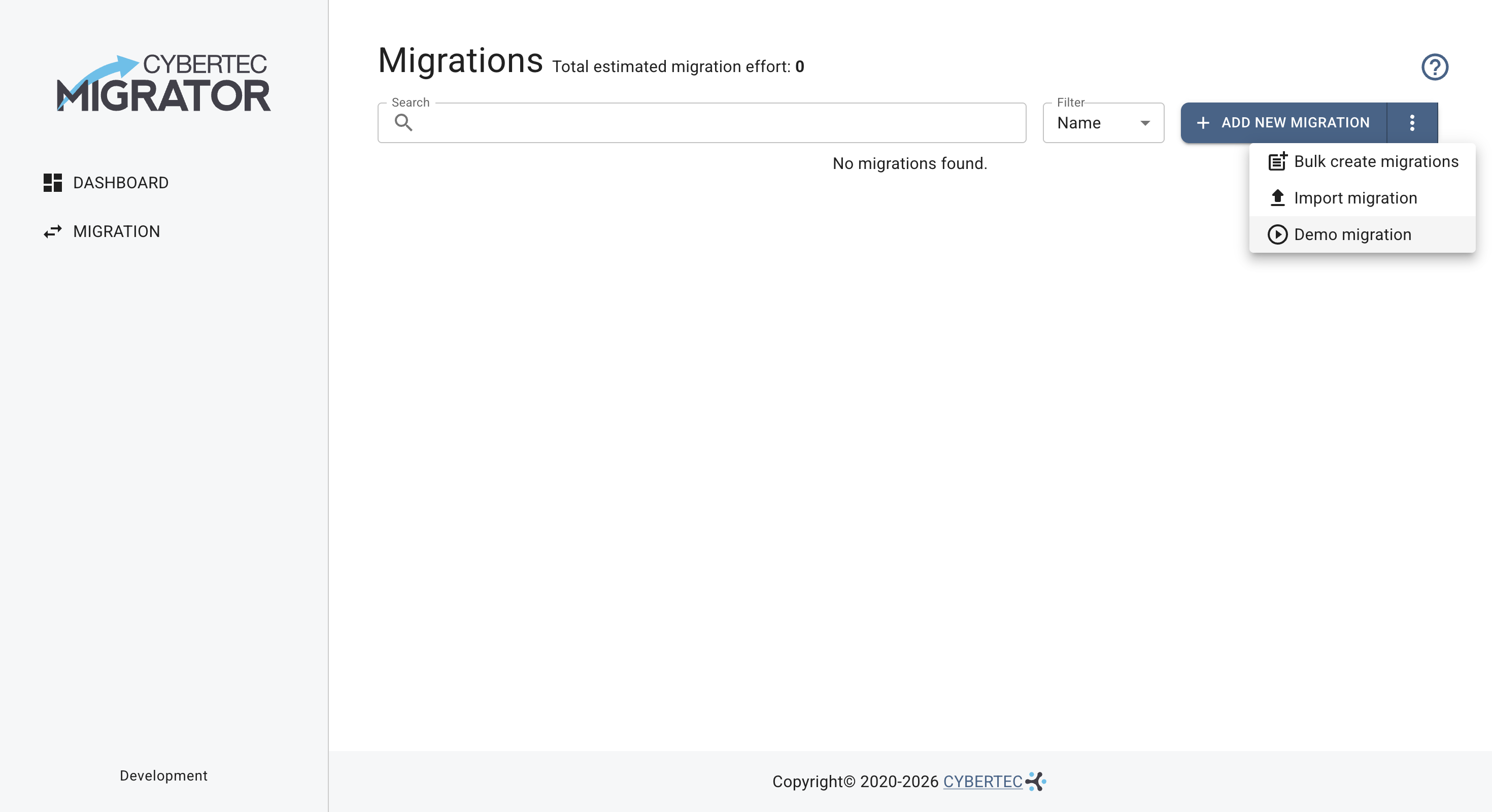
- Evaluate the Migrator instantly with a pre-loaded sample HR schema — no live Oracle database connection required
- Launch a demo from the migrations list via the new “Demo migration” action in the three-dot menu
AI Assistant (Enterprise Edition only):
- Clearer error messages when the AI Assistant cannot be used. Users are now notified if it is not configured, the LLM server cannot be reached, or the API key is unauthorized - with each message advising to contact CYBERTEC
Internal database maintenance enhancements:
- Upgraded the internal database to a custom, fully verified infrastructure to entirely remove default package exposure and ensure a clean environment
- White page when opening a migration with the trial edition
- Transpilation tab does not show all found issues
- Code editors randomly loosing changes
- Transpilation tab flickers on Brave browser
- CVE-2026-21884, CVE-2026-22029 and CVE-2026-22030:
react-router(dependency for facilitating routing in the GUI; affected feature is not used, no vulnerability) - CVE-2026-34077:
react-router(production dependency for facilitating routing in the GUI; denial of service via reflected user input in the Framework Mode single-fetch feature; affected feature is not used, no vulnerability) - CVE-2026-42342:
react-router(production dependency for facilitating routing in the GUI; denial of service via unbounded path expansion in the__manifestendpoint of Framework Mode; affected feature is not used, no vulnerability) - CVE-2025-13465 and CVE-2026-4800:
lodash(dependency for utility functions; affected feature is exposed to external input, no vulnerability) - CVE-2025-12758:
validator(dependency ofclass-validator; used for input validation; affected feature is not in use, no vulnerability) - CVE-2026-23745:
tar(dependency ofnode-gypandcacache; affected only during build time, no vulnerability) - CVE-2026-55388:
piscina(transitive dependency of@pgtyped/clifor SQL type generation during the build process; prototype pollution gadget that may lead to remote code execution via inheritedoptions.filename; not used in production) - GHSA-2rxc-gjrp-vjhx:
anstream(dependency ofclapfor CLI argument parsing) - CVE-2026-27606:
rollup(dependency ofvitefor automated testing; not used in production) - CVE-2026-53571:
vite(dependency ofvitestfor automated testing; not used in production): on Windows,server.fs.denycould be bypassed via NTFS alternate data streams or 8.3 short names when the dev server is exposed to the network - CVE-2026-33228, CVE-2026-32141:
flatted(dependency ofeslintfor code linting and formatting; not used in production) - CVE-2026-27904:
minimatch(dependency for glob pattern matching; regular expression denial of service) - CVE-2026-33671:
picomatch(transitive development dependency for glob pattern matching; ReDoS via crafted extglob patterns such as+(a|aa)causing catastrophic backtracking and Node.js event-loop blocking; not used in production) - CVE-2026-3520:
multer(direct dependency for file uploads; potential for denial of service) - CVE-2026-5079:
multer(direct/production dependency for file uploads; denial of service via deeply nested field names) - CVE-2026-44705:
tmp(development dependency viacypressfor automated testing; path traversal via unsanitizedprefix/postfixvalues that enables directory escape; not used in production) - CVE-2026-44728:
@babel/plugin-transform-modules-systemjs(dependency for the build process; not used in production) - CVE-2026-47429:
vitest(direct dependency for automated testing; not used in production) - GHSA-gv7w-rqvm-qjhr:
esbuild(direct dependency for project bundling; not used in production) - CVE-2026-6321:
fast-uri(dependency ofajvfor JSON schema validation) - CVE-2026-26318:
systeminformation(dependency ofcypressfor automated testing; not used in production) - CVE-2026-12143:
form-data(transitive dependency ofsuperagentfor HTTP testing and of@cypress/requestfor automated testing; CRLF injection via unescaped multipart field names and filenames; not used in production) - CVE-2026-46625:
js-cookie(transitive production dependency ofreact-usefor browser cookie handling in the GUI; per-instance prototype hijack viaassign()enables cookie-attribute injection; affected feature is not in use, no vulnerability) - CVE-2026-4867:
path-to-regexp(transitive production dependency ofexpressviarouting-controllersfor HTTP request routing in the backend; regular expression denial of service via routes with three or more parameters in a single segment; affected pattern is not used in any of the migrator’s routes, no vulnerability) - CVE-2026-4926:
path-to-regexp(transitive production dependency ofexpressviarouting-controllersfor HTTP request routing in the backend; denial of service via sequential optional groups in route patterns whose generated regular expression grows exponentially with the number of groups; affected pattern is not used in any of the migrator’s routes, no vulnerability) - CVE-2026-27959:
koa(transitive production dependency ofrouting-controllersfor the underlying HTTP server framework in the backend; Host header injection viactx.hostname/ctx.originwhich perform naive parsing of theHostheader without validating RFC 3986 hostname syntax, allowing an attacker-controlled value likeevil.com:fake@legitimate.comto be returned as the hostname; affected feature is not used by the migrator, no vulnerability) - CVE-2026-53550:
js-yaml(transitive development dependency ofeslintandcosmiconfigfor parsing YAML configuration files during development and build; quadratic-complexity DoS in merge-key handling via repeated aliases in the<<merge sequence causes CPU exhaustion and Node.js event-loop blocking; not used in production) - CVE-2026-3449:
@tootallnate/once(development dependency, transitive vianode-gyp→make-fetch-happen→http-proxy-agentfor fetching packages from the npm registry during the build process; incorrect control flow scoping in promise resolving when theAbortSignaloption is used; not used in production) - CVE-2026-42338:
ip-address(transitive development dependency viasocks→socks-proxy-agent→make-fetch-happen→node-gypfor building native Node.js addons; cross-site scripting in theAddress6HTML-emitting methodsgroup(),link(), andspanAll(), as well as inAddressError.parseMessage, because attacker-controlled content is embedded into the returned HTML without escaping; not used in production) - GHSA-r4q5-vmmm-2653:
follow-redirects(transitive development dependency viahttp-server→http-proxyfor serving the built frontend locally; when following a cross-domain redirect, only the standardauthorization,proxy-authorization, andcookieheaders are stripped while custom authentication headers such asX-API-KeyorX-Auth-Tokenare forwarded verbatim to the redirect target, leaking them to an attacker-controlled host; not used in production) - GHSA-g7r4-m6w7-qqqr:
esbuild(transitive development dependency ofviteviavitestfor automated testing; not used in production): on Windows, path traversal via backslash separators in the development server’sservedirallows reading arbitrary files outside the configured root directory - CVE-2026-8723:
qs(transitive production dependency ofbody-parserandexpressfor HTTP request parsing in the backend;qs.stringifythrows a synchronousTypeErrorwhen called witharrayFormat: 'comma'andencodeValuesOnly: trueon an array containingnullorundefined, enabling a remotely triggerable denial of service via crafted JSON request bodies; affected options are not used by the migrator, no vulnerability) - CVE-2026-41907:
uuid(direct production dependency for generating RFC 4122 UUIDs in the backend and frontend, as well as transitive production dependency via@ngneat/falsofor random data generation in tests and via@cypress/requestfor HTTP request signing during automated testing; thev3(),v5()andv6()API methods accepted caller-provided output buffers without validating the offset or buffer length, allowing silent partial writes outside the intended 16-byte UUID range and potentially producing malformed identifiers; fixed by updating to^13.0.1and forcing the same version viaresolutionsfor the transitive usages) - CVE-2026-33532:
yaml(direct production dependency in the backend for parsing and stringifying YAML content, and transitive development dependency viacosmiconfig,lint-stagedandopenapi3-tsfor configuration parsing, pre-commit hooks and OpenAPI document generation; the node resolution/composition phase used unbounded recursion, allowing a small crafted YAML document with deeply nested flow sequences (~2–10 KB) to trigger aRangeError: Maximum call stack size exceededand potentially terminate the Node.js process; fixed by updating to^2.8.3) - CVE-2026-24001:
diff(direct production dependency in the frontend and transitive production dependency via@prantlf/jsonlint, as well as transitive development dependency viats-nodefor diffing compiled TypeScript output line-by-line in the interactive REPL; theparsePatchandapplyPatchmethods entered an infinite loop and consumed memory without limit when parsing patches whose filename headers contained the line break characters\r,\u2028, or\u2029, allowing a small crafted patch to trigger a denial of service via process memory exhaustion; additionally, a ReDoS in the patch header with cubic complexity on its length further amplifies the impact; fixed by updating to^8.0.3) - CVE-2025-13466:
body-parser(direct production dependency in the backend for parsing URL-encoded and other HTTP request bodies in theexpress/routing-controllersstack; versions>= 2.2.0 < 2.2.1handled URL-encoded payloads containing a very large number of parameters inefficiently, allowing an attacker to send thousands of parameters within the default 100KB request size limit and cause elevated CPU and memory usage, which could lead to service slowdown or partial outages under sustained malicious traffic; fixed by updating to^2.2.1) - CVE-2025-69873:
ajv(direct production dependency in the frontend for compiling and validating JSON schemas against user-uploaded migration files in the bulk-create flow, and transitive production dependency via@prantlf/jsonlintfor JSON parsing; when the$dataoption is enabled, thepatternkeyword accepts runtime data via JSON Pointer that is passed directly to the JavaScriptRegExp()constructor without validation, allowing an attacker to inject a malicious regex pattern such as^(a|a)*$whose catastrophic backtracking causes full CPU blocking with a single HTTP request and therefore a complete denial of service; fixed by updating to^8.18.0and forcing the same version viaresolutionsfor the transitive usage via@prantlf/jsonlint) - GHSA-j39j-6gw9-jw6h:
git2(development dependency of the backend’s build script for determining the current git commit hash; versions< 0.20.4exhibit undefined behavior because dereferencing theBufstruct immediately after callingnew()ordefault()on it passes a null pointer toslice::from_raw_parts, which according to its safety contract requires a non-null, properly aligned pointer even for zero-length slices; not used in production)